 The Quintana Roo File
ESPEN
The Quintana Roo File
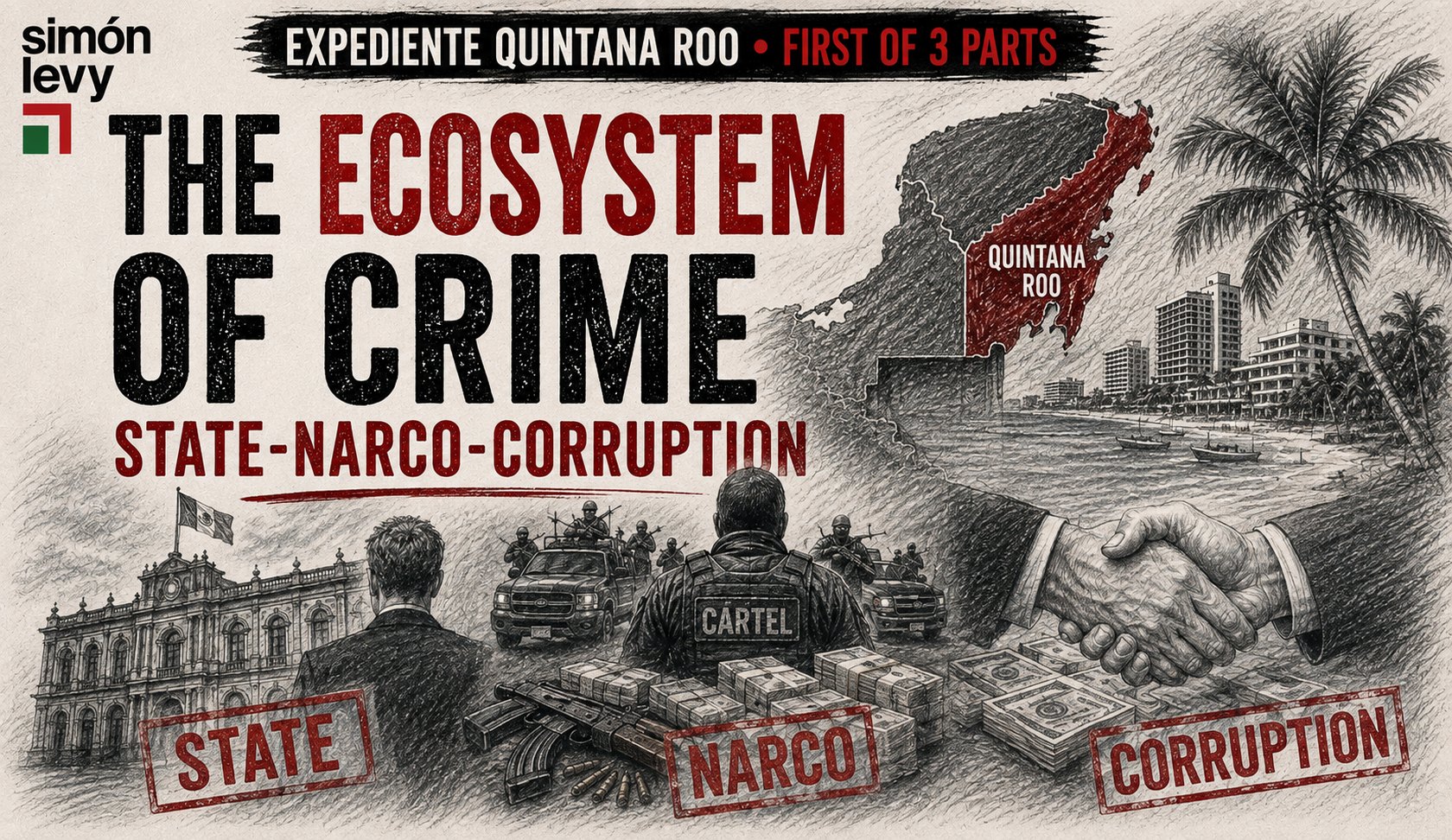
Homicides fell. The charge did not.
Quintana Roo touts its steepest drop in homicides in twelve years. It is true, and it is in official figures. What did not fall is the machine that extracts rent from the territory: the permit window that charges for the license, the notary office that launders the land grab, the call center that defrauds American retirees, and the real estate where it all lands. The protection racket did not disappear. It changed hands.
Quintana Roo does not have a cartel problem. It has a window problem. A window is any desk where someone decides whether your permit comes through or not. The restaurant health license. The zoning change for your lot. The deed that certifies your purchase. The civil protection sign-off. Whoever controls that desk does not need a gun to charge you. Not signing is enough.
For fifteen years, the conversation about this state was about bodies. That conversation ended with good news: the federal government reports the daily average of intentional homicides fell from two per day in September 2024 to 0.3 in June 2026. It is the largest reduction in twelve years, and it comes from official figures.
But rent extraction is not measured in homicides. And that is the finding of this investigation: in the same half-year in which Tulum went two full months without a single homicide, its business owners reported that the ones charging them were no longer organized crime, but the authorities. The protection racket did not leave. It got formalized. It got letterhead.
The cartel charged you to let you live. The window charges you to let you open.
This is the Quintana Roo File, and this is the first of its three parts. Today we analyze the full ecosystem: how the state, the narco, and corruption relate across the territory, who collects, where the money exits, and which U.S. laws already reach it. In Part 2 we will name the operators, the intermediaries who repeat across the notary office, the cadastre, the trust fund, and the port. And in Part 3 we will reach Mara Lezama and her government, with the documents that this first part’s records requests are already producing. There is also a reason of timing to start today: the entire U.S. Treasury file against tourism fraud was built on Puerto Vallarta. Cancun and the Caribbean have not been touched. That void will not last. And when it closes, this series will already have said first where to look.
This investigation assembles that machine piece by piece, from public documents, and explains why it ends in a United States courtroom. Because the victims are American, because the counterparties trade in New York, and because since 2023 there is a U.S. federal statute that no longer punishes only the one who pays the bribe, but the one who demands it.
Eight stops. One idea per stop. No jargon. By the end you know exactly what the file is about and what remains to be proven.
The precedent no one cites, the number they celebrate, the number they ignore, and the route from a Tulum notary office to a U.S. federal court. Part 2 names the operators. Part 3 reaches the government.
Not a hypothesis. A final sentence. And the one fact no coverage of Quintana Roo puts up front.
When someone says the United States "could" look at Quintana Roo, they are making a verb-tense mistake. It already looked. It already prosecuted. It already sentenced.
Mario Villanueva Madrid governs Quintana Roo from 1993 to 1999 for the PRI.
At the end of his term he is charged with drug trafficking and remains a fugitive for two years and two months. He is arrested in 2001.
On May 8 he is extradited to the United States, the first former Mexican governor ever handed over to U.S. authorities.
He admits before the judge that the conduct described consisted of laundering money, carried out with other conspirators. The Manhattan U.S. Attorney drops 13 of the 14 counts.
On June 28 he is sentenced for money laundering. The court imposes 131 months and orders 19 million dollars seized as proceeds of unlawful activity.
The convicted former governor seeks to regain political standing in the state.
What matters is not the biography. It is the jurisdiction. The Southern District of New York established that the accounts, transfers, and assets of a Quintana Roo governor were justiciable in the United States because part of those transactions touched Manhattan. That standard has not expired.
The right question is not whether Washington can look at Quintana Roo. It is what changed in the territory since it did.
This investigation does not dispute the official number. It publishes it in full. Because the official number is exactly what makes the gap visible.
On June 30, 2026, the Executive Secretariat presented its crime incidence report. These are the numbers, uncut and without adjectives.
Tulum, the municipality with the most aggressive real estate boom in the country, went through May and June 2026 without a single intentional homicide, and July opened the same way. June had the lowest daily homicide average in the state in twelve years.
Now look at the last bar. Of all high-impact crimes, the one that fell the least was extortion. It drops 7.7 percent while homicide drops 60. That asymmetry is not statistical noise. It is the shape of the business.
July 2026. Tulum business owners state they managed to nearly eliminate organized crime protection payments. And that now the ones extorting are the authorities.
This is the chapter that turns a security statistic into a corruption investigation.
On July 13, 2026, testimony from Tulum merchants and hoteliers was published. Its content, in their own words: organized-crime protection payments were nearly eliminated thanks to a joint effort, but now the ones committing the extortion are the authorities themselves. A local business leader described it this way: when an inspection arrives, everything indicates the inspection is there to collect, not to advise or assist the business owner.
Three days later, on July 16, the Quintana Roo Health Secretariat preventively removed Emigdio Morales Mezquita from his post. His job title, verbatim: head of the Window (Ventanilla) of the Health Risk Protection Coordination, Central Zone, in Tulum. The word window is in the name of the position.
Two details that are not anecdotes.
One. He is accused of presenting himself as a federal Cofepris inspector when he actually worked for the state coordination. Impersonating federal authority multiplies the fear of the inspected party and erases the trail of whom to complain to.
Two. The only record of him locatable at Cofepris is a certificate showing that in 2023 he completed the training course Code of Ethics and Anticorruption System, issued by the state Finance and Planning Secretariat.
The only paper he left in the federal system was his ethics diploma.
The governor said the Centurion Group, an elite state police and prosecution unit, is investigating the case, and that she is personally reviewing the information. She also suggested the complaints could be political attacks. The Presidency backed the state government and held that when a complaint exists it must be investigated to its final consequences.
This investigation records all three: the business complaints, the removal from the post, and the official statements. No person mentioned has been charged or bound over for trial. The presumption of innocence applies.
What is not opinion is the pattern. A municipality with zero homicides for two months, and business owners saying they are still paying. That is not peace. It is a change of collector.
Six steps. None requires a weapon. All require a signature. Tap each step to see the mechanism.
Land dispossession on the Quintana Roo coast does not work by invasion. It works by document. And that is why it works: at the end of the process, the new owner holds a spotless deed and the original owner holds a twenty-year lawsuit.

Four gears turn the machine: the notary office, the agrarian registry, the municipal cadastre, and the labor conciliation board. None is exotic. All are ordinary offices the law created to provide certainty. When any of the four aligns with the buyer, the system stops protecting the owner and starts producing clean titles over stolen land.
The Mexican Civil Council for Sustainable Forestry (CCMSS) has reported that offices of the National Agrarian Registry and the Agrarian Attorney at times facilitate land privatization, and that the irregular real estate network on the coast remains active through 2025 and 2026, operating through dispossession, presale fraud, document forgery, and irregular developments in Tulum, Playa del Carmen, and Cancun.
Territorial corruption is not detected through the politician. It is detected through the intermediary who repeats.
That is the methodological rule of this file. We are not looking for a name. We are looking for the notary, the tax address, and the sole administrator that appear in transactions that should have nothing to do with each other. When the same node shows up in the land grab, in municipal procurement, and in the vehicle the money exits through, that is the story.
A bylined column published in 2025 case file numbers, company names, deed numbers, and an assignment instrument. Each of those identifiers is verifiable in public registries. This is the verification matrix.
On March 27, 2025, journalist Ricardo Ravelo published an opinion column about Quintana Roo in SinEmbargo. The outlet expressly disclaims editorial responsibility for that space. This investigation does not adopt its conclusions. It adopts its identifiers, because a deed number and a company name are either confirmed or collapse at the Public Registry.
According to that publication, the FGR opened three case files involving the then mayor of Benito Juarez for probable money laundering, organized crime, and abuse of authority, and those files were shelved. The same publication records a criminal complaint filed with SEIDO in September 2020 and ratified in October of that year.
| Published identifier | Where it becomes a document | What it would prove | Status |
|---|---|---|---|
| Case file FED/SEIDO/UEIORPIFAM-QR/0000372/2020 | FGR · existence and status request | Existence and date of determination | Requested |
| Case file FED/FECC/QR/634/2020 | FGR · existence and status request | Existence and date of determination | Requested |
| Case file FECC/FECC-QR/538/2020 | FGR · existence and status request | Existence and date of determination | Requested |
| SEIDO complaint 373/2020 | FGR · processing and determination | Complete procedural path | Requested |
| Public deed 4724 | Q. Roo Public Property Registry | Ownership, date, and declared value | Requested |
| Public deed 112403 | Q. Roo Public Property Registry | Chain of title of the property | Requested |
| Assignment of rights P.A112.433 | Notarial protocol and Property Registry | The parties and object of the swap | Requested |
| Cited company · developer | Public Commerce Registry · articles of incorporation | Partners, administrator, address, purpose | Requested |
| Cited company · real estate firm | Public Commerce Registry · articles of incorporation | Partners, administrator, address, purpose | Requested |
| Cited company · swap counterparty | Commerce Registry and SAT 69-B list | Tax standing and effective control | Requested |
| Notary Office 62 of Quintana Roo | State directory of notaries | Holder, tenure, and simultaneous public offices | Requested |
| Annexation of 15,000 m² of Fonatur land | Benito Juarez city council minutes and Fonatur | Ruling, vote, and legal regime of the lot | Requested |
The most structurally dense fact in the entire publication is not about wealth. It is this: the notary attesting to the purchases is said to have simultaneously held the municipal Urban Development directorship, and the appraiser of those transactions is said to have been the trustee (sindico) of the same city government.
If that is confirmed in the notary directory and the municipal appointments, this is not an individual case. It is the four gears of chapter 04, held by two people. The one who authorizes the land use is the same one who certifies the sale. The one who represents the city legal interest is the same one who sets the price.
The signature that opens the window and the signature that attests cannot be the same hand.
Procedural status, without ambiguity. The cited case files were shelved according to the publication. There is no known charge or binding over of the current governor for these facts. On May 5, 2026, in Chetumal, Maria Elena Hermelinda Lezama Espinosa stated she is not wanted by the DEA, called the accusations completely false, and attributed them to political attacks driven by early electoral timing. That statement is published in full and is part of this file. The full presumption of innocence applies.
And it is not Cancun. That gap is the story.
Since 2023, the U.S. Treasury Department has built, designation by designation, the file on timeshare fraud tied to the Jalisco New Generation Cartel. Nearly all of it is anchored in Puerto Vallarta.
In July 2024, FinCEN, OFAC, and the FBI issued a joint notice instructing financial institutions to detect, identify, and report this fraud committed by Mexico-based criminal organizations. The notice states that the frequent victims are older Americans, including retirees.
In August 2025, OFAC designated four individuals and thirteen companies over timeshare scams in Puerto Vallarta. On February 19, 2026, almost exactly one year after the United States designated eight Latin American cartels as foreign terrorist organizations, OFAC designated five more individuals and nineteen entities in the same scheme, spanning timeshares, real estate, tourism, travel, and automotive services. The same day, Mexico’s UIF added seven parties to its Blocked Persons List.
Puerto Vallarta holds the entire file. The largest timeshare market in Mexico still has not a single designation.
Absence is not proof of cleanliness. It is a gap in the file. And gaps in files get closed.
The scheme, per the official description: fraudsters contact timeshare owners claiming to represent buyers, title companies, or government agencies, and induce them to wire funds for supposed taxes, fees, or closing costs on deals that never happen. The FBI reports victims lose tens of thousands of dollars, and some lose their life savings.
The law firms advising the industry have already said it in plain words: cruise operators and companies with ties to Mexican tourism businesses must review their sanctions exposure. That warning applies to the Mexican Caribbean as much as to the Pacific.
A state fund fed by foreign cruise line money, with an agreed escalation through 2028. Its operating rules, minutes, and financial statements are public by law.
In 2023 the state government and the cruise lines agreed on a five-dollar state fee per cruise passenger to build the Cruise Tourism Promotion Fund. It took effect on January 1, 2025.
The deal did not stop at five dollars. It provides for gradual annual increases up to a cap of twenty-one dollars in 2028, with ceilings reviewable toward 2030, so that cruise lines can price the cost into tickets in advance.
Cozumel receives about four million cruise passengers a year and concentrates more than half of all maritime passengers in Mexico. Multiply by the current fee, then by the escalation. That is the size of the fund.
No accusation is needed here. A records request is. The operating rules, the technical committee minutes, the financial statements, and the list of funded works are mandatory public information. A trust that will not hand over its minutes is already saying something.
Money from a foreign industry, managed by a state trust, with no known public audit. That is not a suspicion. It is a design.
Cozumel is the third busiest cruise port in the world. And its main terminal depends almost entirely on a single company listed in New York.

The island operates four cruise terminals. At the terminal run by SSA Mexico, 90 percent of arrivals belong to a single cruise group, with the rest split among five other lines.
That matters for a precise legal reason: the port’s commercial counterparty is an issuer registered with the U.S. Securities and Exchange Commission. An SEC issuer operating in a jurisdiction where improper charges by authorities are documented has specific books-and-records and internal-controls obligations under 15 U.S.C. 78m(b)(2). No bribe needs to be proven for exposure to exist. It is enough that internal controls fail to catch the payment.
In 2026 Semarnat denied the expansion of Cozumel’s international cruise pier, concluding the environmental impact authorization was not feasible because it could cause severe ecological imbalances in the marine ecosystem. The denial is an official document and opens the port’s environmental file.
A port that moves four million people a year is a customs house. And every customs house is a window.
FinCEN’s Residential Real Estate Rule took effect. Nationwide. No minimum amount. With the beneficial owner identified.
All the rent extracted in the Mexican Caribbean has to land somewhere. Historically, that somewhere has been South Florida and Texas, in cash, through a company or a trust.
That door changed. Since March 1, 2026, every non-financed transfer of U.S. residential real estate to an entity or trust must be reported to FinCEN, including identification of the buyer’s beneficial owners: name, date of birth, address, citizenship, and tax identification number.
The rule is nationwide, has no minimum amount, and permanently replaces the old Geographic Targeting Orders. It covers one-to-four family homes, condos, co-ops, and certain land intended for residential use. Exemptions are narrow and must be assessed case by case. The reports are not public, but they exist, are kept for five years, and are available to investigating authorities.
What was bought before does not disappear. County records in Florida and Texas remain public and remain searchable by anyone.
What a square meter costs on the most expensive axis in Spain, how you verify who owns what, and why this investigation has not yet published a single name in Madrid.

When a Mexican fortune wants to leave Mexico without leaving the language, it goes to Madrid. And within Madrid, it goes to the Salamanca district.
Market estimates place the average purchase price on Calle Serrano at around 10,300 euros per square meter, and above 11,000 on the stretch between Alcala and Goya. Using the Notarial Statistics Portal, built on actual closed sales rather than listings, postal code 28001 reaches 12,300 euros per square meter. The average apartment changing hands in the area measures about 132 square meters, a ticket close to a million and a half euros.
And this detail, published in the Spanish financial press this month, explains why the district matters for a Mexican investigation: real estate agents working with funds and with Venezuelan and Mexican businessmen describe a competition among them over who buys the apartment closest to the Puerta de Alcala. It is not just investment. It is a status signal.
An apartment on Serrano is not bought to live in. It is bought to prove a point.
How many years of full public salary an apartment on that street costs. Move the controls.
In Spain, property ownership is not searched on Google. It is searched at the Property Registry, and the procedure is this.
Step 1. Location report. The index service shows in which registries across all of Spain a person or company holds recorded property. It is a nationwide search. Requesting it requires the DNI or NIE for an individual, or the CIF for a company. Without that number, a name search returns namesakes and proves nothing.
Step 2. Nota simple per property. With the location in hand, you request the extract for each property: nature, ownership, recorded liens, and legal status. The registrar bills around twelve euros per property.
Step 3. The corporate layer. The property is almost never in a personal name. It is held by a limited company with a sole administrator. That administrator is searched in the Commercial Registry and the BORME gazette.
The protocol is published, and the registry requests are underway through counsel in Spain.
Every nota simple that arrives gets published on this page with its property number and unique registry code. This chapter is the foundation of the asset file for Part 3 of this series.
For nearly fifty years, U.S. anticorruption law had an enormous gap: it punished the company that paid the bribe, but not the foreign official who demanded it. The one holding out the hand stayed out of reach.
That ended. The Foreign Extortion Prevention Act, codified as 18 U.S.C. 1352, makes it a U.S. federal crime for a foreign official to demand, seek, or accept anything of value from a U.S. person in exchange for an official act.
Now go back to chapter 03. Tulum business owners, many backed by U.S. capital. American tourists paying bribes to municipal police. Inspections whose function, according to the inspected themselves, is revenue collection. Every one of those charges, if it involves a U.S. person, is a matter for a federal court in the United States.
The window stopped being a municipal matter the day its customer carried a blue passport.
The threshold is no longer who pays. It is who demands.
Each card opens a statute, explains the evidentiary threshold, and says what document triggers it. Tap to open.
This table updates weekly. It does not measure opinions. It measures days.
Corruption does not always leave a signature. But it always leaves a silence. These are the public records requests filed for this investigation. Each row carries a file number, a date, and days elapsed.
When an agency answers that a document the law requires it to keep is nonexistent, that is the finding. It requires no interpretation and admits no denial.
| Request | Authority | Subject | Days without answer |
|---|
Counterparty exposure calculator. For funds, hoteliers, title insurers, cruise lines, and buyers. Move the controls.
Select your profile to see the result.
This file is built in plain sight. Every request filed appears in the chapter 13 table the same day it is filed. Every document that arrives is published in full, including denials. Every person named keeps the presumption of innocence until a competent authority determines otherwise.
What is proven is stated. What is pending is marked as pending. What has no document does not get written. That is the only reason why, when this investigation states something, no one can knock it down.
What comes next. Part 2 publishes the operator graph: the notary, the tax address, and the sole administrator repeating where they should never coincide. Part 3 enters the Mara Lezama government with the documents the silence counter is already producing: the cruise trust, the FGR case files, the appointments, and the asset file. Each installment is built on the file numbers of the one before.
If you hold a document, here is a door. A deed, council minutes, a contract, articles of incorporation, an official letter, an email. Received with identity protection.